The Difference Between Hijri and Gregorian Age: A Comprehensive Guide with Examples
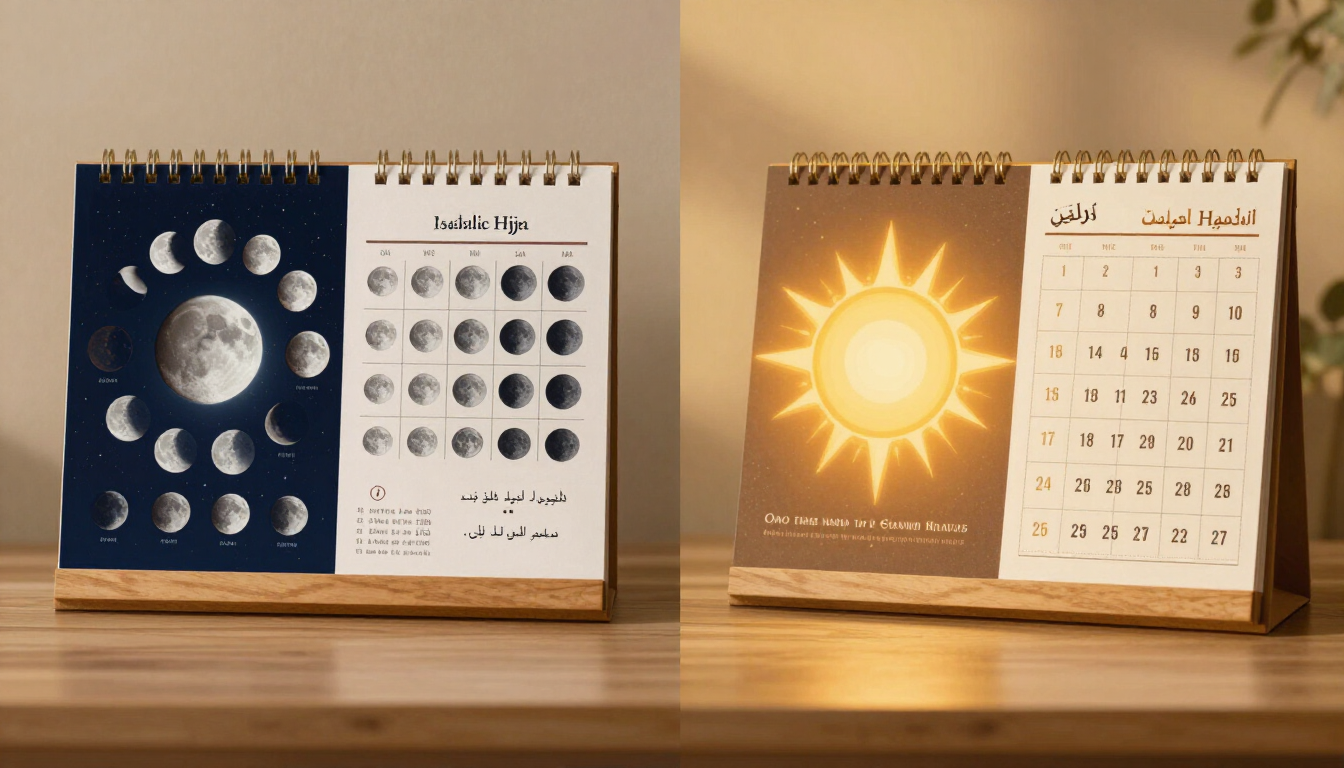
A question many ask when reading their ID card: “Why does my Hijri birth date make me older than I think?” The answer lies in the fundamentally different nature of the two calendars, which we explain here simply with real-life examples.
Two calendars, two principles
The Gregorian calendar is based on the Earth’s orbit around the Sun, while the Hijri calendar is based on the Moon’s orbit around the Earth. This root difference is the source of all the differences we see in dates and ages.
The numerical gap
The Hijri year is shorter than the Gregorian by about 10 days and 21 hours, roughly 11 days. This means the Hijri calendar moves earlier by that amount each cycle.
| Property | Hijri | Gregorian |
|---|---|---|
| Reference | Moon cycle | Sun cycle |
| Normal year days | 354 | 365 |
| Annual gap | ~11 days | |
| Full cycle (alignment) | every ~33 years | |
How does age differ between the two?
Because of this accumulating gap, Hijri age is always larger than Gregorian, and the gap grows with age. The approximate rule: Hijri age = Gregorian age × 1.0307.
| Gregorian age | Approx. Hijri age | Gap |
|---|---|---|
| 10 years | 10.3 | ~4 months |
| 30 years | 30.9 | ~11 months |
| 50 years | 51.5 | ~18 months |
For an exact result, use the Hijri-Gregorian age calculator.
When do you need age in both calendars?
- Religious matters: zakat, waiting periods, Ramadan and Hajj rely on the Hijri calendar.
- Official documents: some Gulf states issue IDs with both dates.
- Family planning: some families record births in Hijri to celebrate occasions on the Hijri calendar.
Conclusion
The difference between Hijri and Gregorian age is not just numbers; it has practical extensions in religious, official and personal life. In short: the Hijri year is shorter by about 11 days, and Hijri age exceeds Gregorian by about 3%. To skip manual calculation, try the free age calculator, or contact us if you need help. See the About page to learn more about our team.
Frequently Asked Questions
How much does Hijri age differ from Gregorian?
In general, Hijri age is about 3% larger than Gregorian. Every 100 Gregorian years equal about 103 Hijri years. The exact gap depends on the exact birth date.
What is the Hijri year and how many days does it have?
The Hijri year is lunar, based on moon cycles, with 12 months of 29 or 30 days. A normal year has 354 days and a leap year 355.
Why does Ramadan shift every year?
Because the Hijri year is shorter than the Gregorian by about 11 days, Ramadan moves earlier by that much each Gregorian year, cycling through all seasons about every 33 years.
How do I calculate my Hijri age if I only know my Gregorian birth date?
Convert your Gregorian birth date to Hijri first, then subtract it from today’s Hijri date. The easiest way is our age calculator, which does this conversion automatically.
Are Hijri month lengths fixed?
No, months alternate between 29 and 30 days and are originally set by crescent sighting, so the start may differ by a day between countries.
Can I rely on automatic date conversion?
Yes, modern conversion tools are highly accurate, but they use fixed astronomical calculations while the official Hijri calendar relies on crescent sighting that may differ by a day. For practical purposes, electronic tools are sufficient.
Related Calculators
Subscribe for new calculators & articles
We send you new calculators and articles as they arrive — no spam, and you can unsubscribe anytime.